

I’ve spent years working inside home renovations in Texas, not just planning them on paper. I’ve watched projects increase a home’s value, and I’ve watched others quietly drain savings.
In almost every bad outcome, the warning signs were there from day one. But many homeowners either miss them or don’t realize how serious they are. If you’re unsure where to begin your project without feeling overwhelmed, you’re not alone. Understanding where to start when remodeling your home in Houston can help you find your footing.
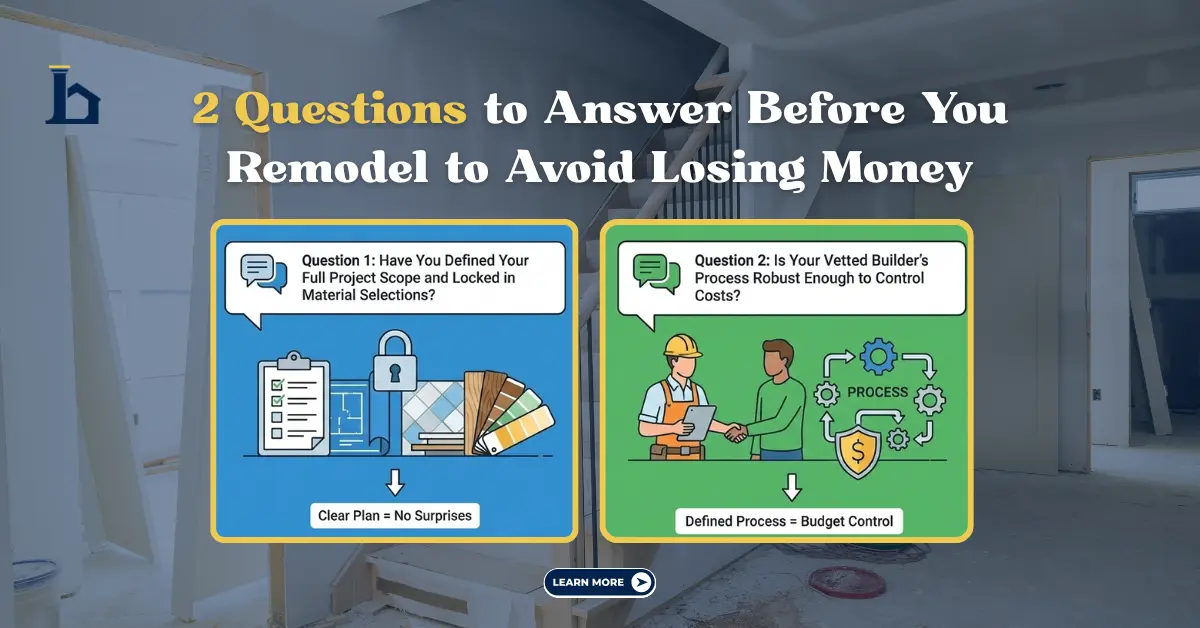
Most remodeling problems don’t come from bad materials or lazy crews. They come from missing decisions made too late. Before you remodel, there are two questions I always walk homeowners through. These questions decide whether your renovation protects your money or puts it at risk.
When you answer them honestly, your project stays controlled. When you skip them, costs rise without warning.
Key Takeaways
- Start with goals, not finishes: Know how you live, how long you will stay, and what matters most so every decision supports function and ROI.
- Use the 30% rule as your budget ceiling: Keep the renovation budget under 30% of your home’s value to reduce over-improving risk and protect ROI.
- Lock in all selections before construction: If it is not selected, it is not truly priced. Late selections trigger delays and change orders.
- Vet your builder thoroughly, not just the bid: Ask for an itemized scope, how change orders are handled, proof of insurance, and a milestone-based payment schedule.
- Plan for hidden and soft costs upfront: Build in contingency funds (10% to 20%), plus temporary living, waste disposal, permit and inspection fees, and possible schedule overruns.
Question 1: Have You Defined Your Full Project Scope and Locked in Material Selections?
I see this mistake more than any other. Texas homeowners start with a vision, but not a full scope. They know they want a renovation, but they haven’t defined how far it goes, what it includes, or where it stops.
When the scope isn’t clear, the budget becomes flexible in the worst way.
Every decision feels small in the moment. New finishes. Slight layout changes. Better fixtures. Each one adds cost, and together they weaken your ROI.
A clear scope gives your renovation direction. It ties your goals, budget, and long-term value together.
So, Before You Begin, Ask Yourself: What Are Your Core Goals and Desired ROI?
Before you remodel, you need to be clear on what the renovation must achieve. You need to plan better daily function, long-term comfort, or resale value. Those goals should guide every decision.
I never start with finishes. I start with goals. For a structured approach to this crucial planning phase, there are steps to know where to start when remodeling your home. I ask you how you live in the home today.
I ask how long you plan to stay. I ask whether resale matters or comfort matters more. These answers shape everything that follows.
At Legacy Custom Home Remodeling, I once worked with a homeowner in Texas who wanted a “modern” kitchen.
After talking, it became clear that the real issue was function. They cooked every night, storage was tight, and the layout caused constant congestion. Once we focused on performance instead of appearance, the renovation made sense and added real value.
Your goals should balance comfort and ROI.
If resale matters, layout and functionality matter more than style. Buyers respond to flow, storage, lighting, and usability. When your goals are clear, your renovation decisions stop being emotional and start being strategic.
Applying the 30% Rule in Remodeling
The 30% rule means your total home renovation budget should stay under 30% of your home’s current market value to protect your return on investment.
The idea is simple.
Your total renovation budget should stay under 30% of your home’s current market value. This helps you avoid over-improving and protects your return on investment when it’s time to sell.
Sounds impossible to maintain? Well, it’s not. Let me give you a real example-
If your home is worth $400,000, your renovation budget should ideally stay under $120,000. That number creates a clear ceiling. It doesn’t mean you must spend that much. It means going beyond it increases financial risk.
I’ve seen homeowners ignore this rule because they planned to stay long-term. Then life changed. A job move. A family shift. A sale sooner than expected. When that happened, they couldn’t recover what they spent.
But to do the calculation, don’t guess the home price. Cause taxas home market moves depending on some facts.
So, you should either use a recent appraisal or talk to a local real estate agent who knows what homes like yours are actually selling for. After that, sit down to do the math. Here is how you can do it-
Multiply the home value by 0.30. Example:
- Home value: $400,000
- $400,000 × 0.30 = $120,000
That $120,000 becomes the maximum renovation budget I’m comfortable with.
Within that number, you need to focus on upgrades that buyers and homeowners both care about:
- Kitchens and bathrooms
- Layout and flow improvements
- Storage, lighting, and functional upgrades
If new ideas push the budget past $120,000, you need stop and reassess. That’s the point at which over-improving starts to eat into ROI rather than protect it.
This rule helps you to keep renovations financially sensible. It prevents overcapitalizing on features buyers won’t pay extra for. It also forces smart decisions about scope, helping you focus on upgrades that improve function, comfort, and long-term value without draining equity.
Mitigating Change Order Risk: Finalize All Selections Before Construction
The best way to avoid costly change orders is to finalize all material and finish selections before construction begins.
Change orders are where budgets quietly fail.
Most change orders don’t come from mistakes. They come from late selections. Cabinets not chosen. Tile undecided. Fixtures still “to be confirmed.” Once construction starts, every delay costs money.
I’ve seen a small finish change add thousands because crews had to stop, materials had to be reordered, and timelines slipped. Late selections affect labor, scheduling, and overall cost.
If it’s not selected, it’s not priced. I tell every homeowner this. Locking in finishes before construction starts is one of the strongest ways to protect your budget and timeline.

Question 2: Is Your Vetted Builder’s Process Robust Enough to Control Costs?
Yes, even a perfect scope can fail with the wrong builder process. A good builder doesn’t just build. They manage risk, costs, people, and expectations. Understanding the essential stages of a Houston remodel can help you evaluate the process.
I’ve stepped into projects where the lowest bid won. Those jobs almost always ended with high change orders and frustration. A strong builder process matters more than a cheap number on paper.
How to Vet a Builder to Avoid Low-Ball Bids and High Change Orders
The safest way to avoid low-ball bids and excessive change orders is to hire a builder with proven experience in projects similar to yours.
We know Low bids look attractive. I understand why.
But they often hide missing scope or unrealistic assumptions from HGTV Builders with experience in complex renovations, and price accurately because they’ve seen the problems before they happen.
I always advise homeowners to ask about past projects similar to theirs. Ask how change orders are handled. Ask how the builder manages unforeseen issues. Experience is the best defense against surprise costs.
A builder who understands scope protects your renovation value and your budget.
Securing Your Project: Payment Schedule, Warranty, and Liability
You secure your remodel by using a milestone-based payment schedule, requiring written warranties, and confirming proper liability coverage.
A solid payment schedule protects you. Payments should be tied to milestones, not calendar dates. Work completed. Inspections passed. Clear progress has been made.
I’ve seen homeowners lose leverage by paying too much too early. A clear payment schedule keeps everyone aligned. It reduces financial risk and keeps the project moving forward.
A written warranty also matters. It should cover labor and materials and clearly explain how issues are reported and resolved.
This isn’t paperwork. It’s protection.
The Subcontractor and Clean-Up Clause: Asking About the Crew and the Dust
You can protect your home by knowing who will be working inside it and by locking in clear, clean-up standards in the contract.
Texas homeowners often worry about who will actually be in their home. That’s a fair concern. Ask who the subcontractors are, how long the builder has worked with them, and who supervises daily work.
Dust and noise are unavoidable, but chaos is not.
I always include clean-up expectations in the contract. Daily clean-up, dust control, and jobsite organization protect your living space and your sanity.

Hidden Costs and Unexpected Disruptions: What Homeowners Wish They Knew
Some costs don’t show up in the initial plan before you start remodeling. HVAC, plumbing, electrical, and temporary living arrangements are often overlooked. I’ve seen homeowners regret not addressing these while the walls were open.
Even after all the calculations and all, make yourself prepare to bear some unexpected cost, like-
|
Cost Area |
Typical Cost Range |
Why It Gets Missed |
|
HVAC upgrades |
$3,000 – $10,000 |
Not visible until walls or ceilings open |
|
Ductwork changes |
$1,500 – $6,000 |
Hidden behind walls and floors |
|
Electrical updates |
$2,000 – $8,000 |
Older homes aren’t built for modern loads |
|
Plumbing upgrades |
$1,500 – $7,000 |
Pipes look “fine” until exposed |
|
Permit & inspection fees |
$500 – $3,000 |
Often assumed to be “included.” |
|
Dust control & clean-up |
$500 – $2,000 |
Rarely discussed upfront |
|
Temporary living costs |
$1,000 – $6,000+ |
Homeowners assume they can “push through.” |
|
Schedule overruns |
5–15% of the project cost |
Delays aren’t planned for |
Budgeting for Structural Surprises: Mold, Electrical, and Water Damage
I always prepare homeowners for what demolition can reveal. Even solid-looking homes can hide mold, water damage, or outdated electrical and plumbing systems behind the walls. These aren’t upgrades you can skip. They must be fixed for safety and code.
That’s why I recommend a 10–20% contingency fund in every renovation budget.
- Set it aside before work starts
- Use it only for hidden structural issues found during demolition
- Keep it separate from design upgrades
For example, on a $100,000 renovation, I reserve $10,000 to $20,000 for surprises. If we don’t need it, great. If we do, the project keeps moving without panic.
This buffer protects your budget and lets structural problems be fixed the right way, not rushed or ignored.
The Soft Costs: Accounting for Temporary Living and Waste Disposal
Many Texas homeowners focus on materials and labor, but soft costs can quietly inflate your renovation budget. These are expenses that aren’t tied directly to construction, but they still affect your wallet and daily life.
2 of the highest soft costs I see are temporary living arrangements and waste disposal.
- Temporary living: If your kitchen or bathroom is unusable during the remodel, you might need to eat out, stay elsewhere, or set up a temporary kitchen. Planning ahead prevents daily stress and unexpected expenses.
- Waste disposal: Renovation generates a lot of debrisold cabinets, drywall, tile, and more. Dumpster rental and disposal fees can add up quickly if you don’t include them in your budget.
For example, a three-month kitchen and bathroom renovation could easily cost $1,500–$3,000 for temporary living arrangements and waste removal.
I always advise clients to plan these costs upfront to avoid surprises and keep the project running smoothly.
You need to add up those soft costs in your calculation, too. Otherwise, the sudden spending may panic you. So keep it in mind. It keeps your renovation realistic, your budget intact, and your life disruption manageable.

Hiring a Contractor To Remodel a Home Without Losing Money or Time
Right/wrong builder matters a lot in remodeling.
I’ve seen projects with home remodeling plans fail simply because the contractor couldn’t manage scope, costs, or surprises.
But at Legacy Custom Home Remodeling, we don’t let down our clients like that. We have over 36 years of experience, a licensed and insured team. So we know what to do and how to do it.
What Questions Should I Ask a Contractor Before Remodeling?
We will do our part, but you should do yours as a Texas homeowner. Cause asking the right questions upfront can prevent costly mistakes:
- “Will you provide an itemized bid detailing scope and costs?”
Legacy always provides fully itemized bids. Lump-sum bids hide markups and allowances that can balloon your costs later. - “What is your process for handling hidden issues and change orders?”
Their structured approach ensures mold, electrical, plumbing, or structural surprises are managed efficiently, keeping your project moving on schedule. - “Can you provide proof of liability insurance and Workers’ Compensation?”
With Legacy, every worker is covered. You’re protected from liability, giving you peace of mind. - “How do you manage the project schedule to minimize material delays?”
Legacy coordinates every subcontractor and delivery, so delays don’t derail your timeline or budget. - “Will you provide a written, milestone-based payment schedule?”
Payments are tied to completed milestones, ensuring your money is safe while work progresses smoothly.
What Not to Tell Your Contractor?
We are not based like other builders. So, before hiring calling us or anyone, be aware & avoid telling some things. Smart homeowners protect their budget and scope by avoiding common pitfalls:
- Don’t reveal your maximum budget upfront. Fixed pricing means you get the scope you want without guesswork.
- Don’t share personal financial details. You should focus the conversation on project goals, not your bank account.
- Don’t accept vague allowances. You should lock in selections with clear costs to prevent surprise change orders.
- Don’t negotiate the payment schedule
Share & plan, but don’t need to share everything upfront.
How To Make A Contract With A Remodel Contractor?
Creating a solid contract is one of the most important steps before any remodel begins.
I’ve seen too many homeowners jump in without a written agreement, only to face delays, unexpected costs, or disagreements that could have been avoided. A well-crafted contract protects both you and the contractor while keeping your project on track.
Here’s how I guide homeowners through making a contract with a remodel contractor:
1. Define the Scope of Work Clearly
Your contract should detail exactly what the remodel includes. I always recommend breaking down each area, kitchen, bathroom, living space, and specifying tasks like demolition, electrical, plumbing, flooring, and finishes.
A vague scope leads to misunderstandings and costly change orders. Clear details ensure everyone is on the same page.
2. Include an Itemized Budget
Never rely on a lump-sum number alone. Your contract should list costs for labor, materials, permits, and any other fees.
Example: Instead of saying “Kitchen remodel: $25,000,” the contract should specify:
- Cabinets: $8,000
- Countertops: $4,000
- Flooring: $3,500
- Labor: $9,500
This makes it easy to track spending and prevents surprises.
3. Set a Payment Schedule Tied to Milestones
Payments should be linked to completed work, not calendar dates. I usually recommend something like:
- 10% upfront deposit
- 30% after demolition and prep
- 30% after rough-in work (plumbing/electrical)
- 20% after finishes
- 10% final payment after inspection and approval
This protects you and ensures the contractor stays accountable.
4. Include a Contingency Clause
Even with a clear scope, hidden issues such as mold, water damage, or electrical issues can arise. I suggest including a 10–20% contingency fund in the contract to cover these unexpected costs without stopping the project.
5. Specify Materials and Selections
Lock in all materials, finishes, and fixtures in the contract. Include brand, model, and color whenever possible. Last-minute changes are the biggest source of change orders and budget overruns. Clear selections upfront protect your investment.

6. Include Warranty and Insurance Details
The contract should state what’s covered, for how long, and how to report issues. Confirm that the contractor has liability insurance and Workers’ Compensation to protect you from financial risk.
7. Add a Timeline and Completion Date
Include start and end dates, as well as allowances for unavoidable delays like weather. This gives you a clear expectation and helps measure progress.
8. Outline Dispute Resolution
Even with a trusted contractor, disagreements can happen. Include a clause that explains how disputes will be handled. You need to see through mediation or arbitration, which is often recommended.
A strong contract isn’t just paperwork. It’s your roadmap for a smooth remodel.
Clear scope, itemized costs, milestone payments, contingency planning. Basically, proper insurance creates a foundation for a successful project and protects your budget, your home, and your peace of mind.
Conclusion
After working on hundreds of remodels, I’ve learned the difference between projects that succeed and those that drain budgets: planning. The mistakes I see aren’t about materials or crews. They’re about late decisions.
Define your scope, lock in materials, follow the 30% rule, and choose a builder with a solid process. Add contingency funds, plan for soft costs, and put it all in a clear contract. Do this, and surprises won’t derail your remodel.
With the right prep and team, your renovation becomes predictable, valuable, and stress-free.
FAQ
What should I have ready before I first call a remodeler?
Being prepared makes that initial conversation far more productive. Before you dial, check out our checklist on what to prepare for your first call to a remodeler to ensure you cover all the key points and get the most out of the discussion.
Can remodeling affect my property taxes in Texas?
Yes, it can. Major renovations that increase your home’s value may trigger a reassessment. I always tell homeowners to factor this into long-term planning, especially after large kitchen or structural upgrades.
Should I notify my neighbors before a major remodel?
Absolutely. Noise, dumpsters, and blocked driveways create tension fast. A quick heads-up prevents complaints and keeps things smoother during inspections and deliveries.
How early should I order materials before construction starts?
Earlier than you think. Some materials have long lead times. I’ve seen projects delayed weeks because cabinets or windows weren’t ordered early enough. Ordering upfront protects your schedule.
What happens if I want to pause the project mid-remodel?
Pausing costs money. Crews reschedule, materials sit, and timelines reset. If a pause might happen, it needs to be written into the contract so expectations are clear on both sides.

Bobby Nation, a second-generation contractor with 35 years of experience, leads every project with expertise and dedication. He works closely with homeowners, guiding them through each step of the remodeling process to ensure a smooth experience and results that meet their goals.